Tuesday, August 17, 2010

Week 4 Tutespark. Big screen to small screen.

This is a australian short movie about a couple who has a love fight, and things gets really bad. It is shocking and hilarious.The thing that makes this short film worth seeing is the tention that is built up in the viewers at all times. We know that something is going to happen, and the stuf that do happend, is shocking, terrible and hilarious at the same time. I think it`s really great that the film also are an australian.


This a short movie made for the internet. It was made to compete in a film festival of short movies from different countries of the world. People watch them online and vote, then they have a festival where the winners gets a price.
http://www.cortoweb.com/icfilms/eng/contest.php


This is a short scary movie. That tricks your brain. It is a bit strange at first, but then it gets really creepy! This film will be popular because it makes the viewers wanna find out more.

Sunday, August 15, 2010

The tutespark week 3. Three digital devices.


The tutespark this week was to find three digital devices that are not electronic that is used to communicate.

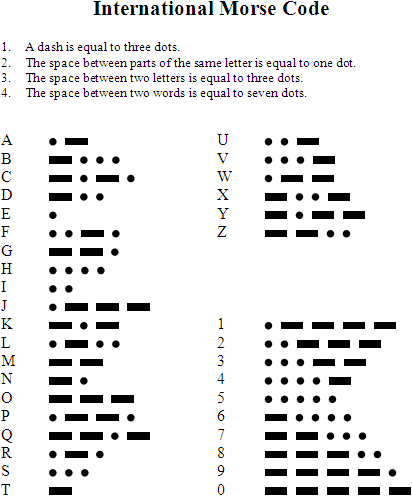
1: The first thing that I think about when I read this question is the Morse code.


2: I did some research online and I found something called the Braille a-system. It says that the braille system is a "tactile system of raised dots representing letters of the alphabet." This is the most effective system to contact the blind people. And the web page says it was invented in Paris by a man named Louis Braille.

http://www.cnib.ca/en/living/braille/braille-system/default.aspx
http://pmr-science.wikispaces.com/file/view/Braille.gif/32414381/Braille.gif


3: The last thing I found was the Sputnik. A russian satellite that was shot out to the space in the 1950s to gather information about the space.


http://en.wikipedia.org/wiki/Sputnik_1

Response to lecture week 3.

"A Short History of Computing and the Internet".

This week the lecture ws about the history of computers and the internet. In this 50 min lecture we got to learn some new things, and some I did know from before. I think this i s a very interesting topic, and it is a topic that we can discuss for ages.

If we start to look at networking, there was a time before computers. Back in the old days the networking went through books. And the development from that stage until now is an interesting journey. If we take a look at the digital technology, we can say that old cash registers is a form of a old digital technology, because it could calculate. The mechanical computer devices did rulled before we had digital computers. If we look at the history there is always more technology invented after a war. During world war 2, they used several communication forms and technologies to delete the enemy and keep things a secret. These technologies gets more developed after the war and becomes the seeds for todays computers, internet and technology.
Radio = radar = computers!

The first Pc was released in 1975. This was a quite large computer, and did weigh a lot. The biggest problem with this computer was that it didn`t hav eany language. And this issue made people like Bill Gates excited. He dropped out of school and started ineventing a language for the Altair called BASIC, and to make people buy this program he started a little company, actually in his garage, called Microsoft! And more and more companies transferd into the PC world!

More and more people, or computer "nerds" as we call them, started exchange ideas. And this led to the start of the Apple. To men, Steve Jobs and Steve Wozniak, produced the Apple 1. They made this product for people who were more interested in the software and the possibilities then the PC hardware. These computers became a hit, and the guys sold a lot of it. So when Steve Jobs where 25 years old, he wa worth $100 million dollars!

Today the computers/Mac is much faster, and everything goes online. The internet is what controls the world. There is computers everywhere. The development of the internet started after the Sputnik 1 was invented by the russians. the US feared that they would take over, so they inevnted the internet from the late 1950s to the early 1970s in the US, by a group of people. And as many think, it was not Al Gore who invented the internet.

I think this was a really interesting and exciting lecture, and I can hardly stop writing about this topic. I think that it is really interesting to find out who made the internet, when was invented, and everything about the computers development.

Sunday, August 8, 2010

Response to lecture week 2.

This week we learned about how the language of the cinema works. There is different types of way to express a situation, and show the viewers what is happening in the movie. We have the 5 W, and H, that is used to put together a story. The 5 W`s is: what, when, where, who and why, and then comes the H, that is: how. To make a story out of this we have to use different shots to show the viewers the story. There are many different shots sizes that we use, from very long shot to extreme close up.

To answer the 5 W`s and the H we use different shots. The who is answered by taking a picture close up to the caracter, that shows the face very clearly. The what is answered when you take a picture with the caracter in action, it is good to use a mid shot when taking this picture. The where is taking with a long shot, to show where the caracter is. The when is showing when things happens, what time it is, and so on, and it`s commone to use both a wide shot and the close up. The why is answered by taking a big close up picture to reveal something about the caracter or the situation. The how is a tricky one, and can be a bit hard to answer sometimes, it explain what is happening, like an event or something. So it is common to take a series of close up pictures or just use a medium close up picture.

When you take pictures, there is many things to think about. How the person is standing in the picture and how the picture view is. The rule of thirds tells you to not put the person in the middle of the picture, but a bit to the side, so it creates a balance in the picture. It is also important to remember that the person has "head room" and "talking room". Head room is taking a picture of the caracter when you have just enough space for the whole head, and half the upper body. The talking room is a bit more close up, and you show more of the head than in the "head room" shot, and it is important to remember not to put the caracter to far to the side in the picture. That is why the rule of thirds has to be used all the way.

When to caracters are going to talk to each other in the scene, the 180 degree rule breaks in. The two people are facing each other in a way that makes an 180 degree line on each side of them. To make the viewers more interested and drive their curiosity forward, you have to take a picture that makes a statement. Like when there is a picture of the caracter running away from the killer, or a close up picture of the caracter when it makes a scared face when he/she saw something terrible.

Wednesday, August 4, 2010

Maren in Australia!

My name is Maren, and I have recently moved to Australia from Norway to study at Giffith University:) I really love the weather and the people down here:) I am doing a bachelor degree in communication, so I am going to be here for three years:)